I think (I hope) spring might actually be on its way. I've heard titmice and cardinals beginning to test out their spring songs on recent sunny (but still below-freezing) days, and the weather report is predicting near-50-degree temperatures next week. (So exciting!)
But this post is not about spring's much anticipated arrival. Oh no. This post is about one of the most severe things I've seen during the past two severely cold months.
Last Monday (February 23), I stopped briefly at Miller Road Park in Avon Lake to see Lake Erie, which was at this point basically a never-ending landscape of ice and snow:
Lake Erie always astonishes me whenever I see it, but this is something else.
Actually, almost all of the lake that I could see was frozen. A power plant next to the park pumps warm water into the lake, which keeps this small section of the lake from freezing over. And that's the other reason I stopped at this spot, because without other open water in the area, this place was absolutely packed with thousands of ducks:
I mean, I still can't really fathom this. I did a conservative count from the pictures I took, and I came up with an estimated 1,000 Red-breasted Mergansers and 3,000 Common Mergansers, which were the most numerous birds there. What?? The highest number of Common Mergansers I'd seen in one place before this was somewhere around 30, and I thought that was a lot. Most of the birds in the above picture are Common Mergansers. Here's another view of that massive group:
I mean, what is this? That's way too many Common Mergansers, mostly tuxedo-ed males:
These birds made quite a sight in flight as well:
The other side of the open water was also packed with ducks, and about 100 Great Black-backed Gulls (again, another bird I've only seen in small numbers before) lined the edge of the ice:
Dense groups of Red-breasted Mergansers looked a bit like big fuzzy caterpillars with all those wild hairdoes:
Sleek Common Mergansers and frizzy Red-breasted Mergansers, with Great Black-backed Gulls looking on:
Other birds were less numerous, but still very cool to see. About 100 Canada Geese congregated in one corner of the pool:
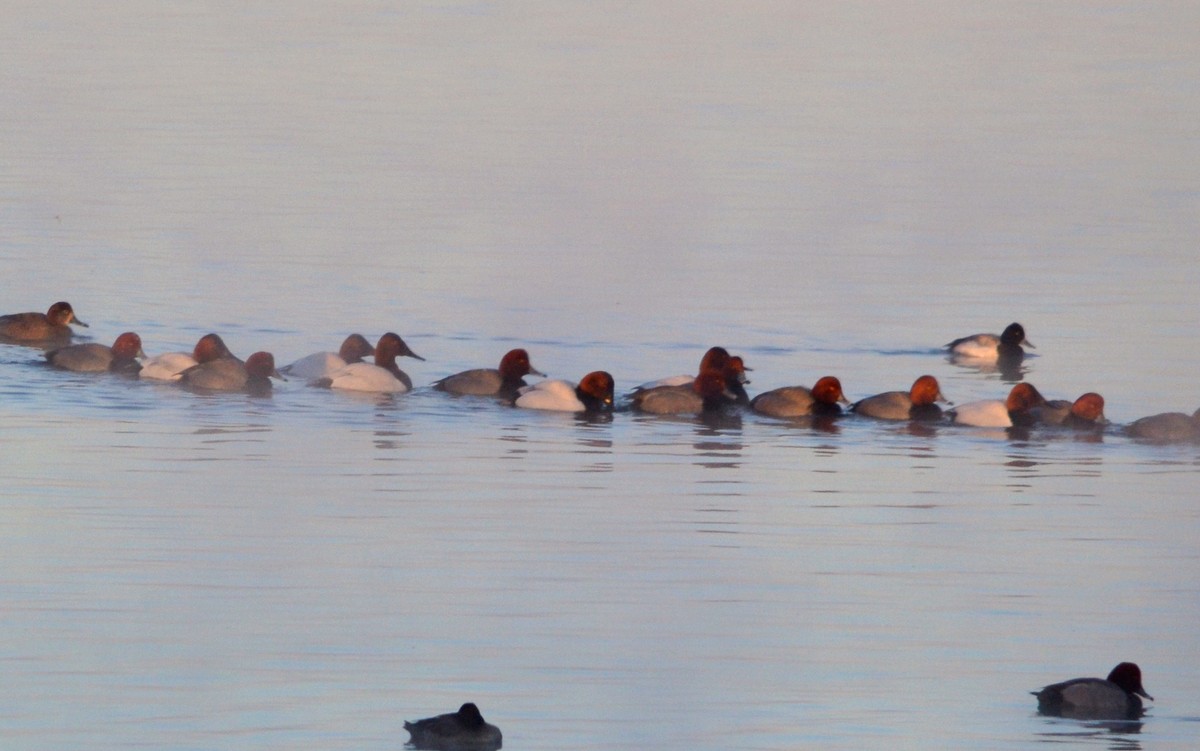
Groups of Redheads and Canvasbacks (the brighter white birds with funny sloping beaks) looked stunning in the setting sun:
And several male Common Goldeneyes were looking extra fancy with their stark black and white costumes and white face patches:
I think the huge numbers of Common Mergansers were my favorite part of the scene, though. When else am I going to get to see a parade of these gorgeous birds?
My fingers were numb after about 10 minutes of standing in this awesome place. I wish I could have stayed longer, but yeah, it was really cold. I feel like I've now seen how extreme winter in northern Ohio can be, and it was incredible and intense. And now it's time for spring.
On Monday afternoon I was out shopping and found myself next to Lake Erie. It was a beautiful sunny day -- quite rare around here lately -- and I had brought my camera and binoculars with me, so I settled down on the town's public beach to watch the water.
I guess I still haven't posted much here about this Great Lake, which is crazy, because I'm astonished every time I encounter it. This lake is so much more ocean-like to me than the Long Island Sound (which is my ocean paradigm after living in Connecticut) mostly because I can't see the land on the other side, and also because I've already seen bigger waves here than I usually saw in Connecticut. On Monday, though, the lake was surreal, with flat, barely moving water that blended exactly with the sky in the low afternoon light. This has got to be one of the strangest landscapes (or maybe make that water-scapes) I've seen:
It took a big passing barge to create the horizon with its wake:
Aside from the amazing water-scenery, I had a lot of fun meeting the local birds as well. Ring-billed Gulls made up most of the population, and the lighting was just perfect for pictures of these handsome birds as they moved from water to shore:
There was quite a bit of jostling on the beach every time one of the gulls came in for a landing:
The Ring-billed Gulls made handsome sights on the reflective water as well:
But mostly I just had way too much fun taking pictures of them in flight:
A Great Black-Backed Gull loomed over the smaller Ring-billed Gulls from its rock:
Several ducks made brief appearances as well. These two female (or immature male) Buffleheads came closer to shore when the barge went past:
And then they took off in a series of splashes:
This bigger group of Buffleheads made a water landing a little further away, the males showing off their pink clown feet (ducks can be so funny looking):
A few Common Mergansers flew past, too, a bit like arrows with those pointy beaks:
With so many interesting creatures and sights, visiting Lake Erie is always a good idea.
Every week when I visit Silver Sands State Park, I get a little more attached to the place. I love getting to check in with familiar creatures, and there's always something new to see! Here are a few sights (mostly birds) from this morning's visit.
The Piping Plover chicks east of the park are getting even closer to adulthood (including the chick with the injured leg, who's still running around and foraging with its siblings as of this morning). It looks like they just need some longer wing and tail feathers, and then they should be good to go!
While the four chicks foraged in the sand, Dad kept careful watch; he even chased a House Sparrow away at one point. A folded mat makes a convenient lookout perch:
The plovers aren't the only bird family with growing babies around here, of course. I was very happy to see a gangly Clapper Rail chick wander out of the marsh grass; such a cute little dinosaur-like creature:
The Barn Swallows are nesting under the boardwalk, and this adult perched on the railing for a rest between hunting flights:
There were actually dozens of swallows hunting in the air over the marsh, more than I think I've ever seen here at once. The swirling (and chittering) cloud of birds was mostly made of Barn Swallows, but there were also several Tree Swallows in the mix, as well as a few Chimney Swifts, which I've definitely never seen hunting in this spot before. This picture may not look like much, but its quite a busy scene for this airspace:
On the beach, a pair of Great Black-backed Gulls made an imposing sight:
I'm surprised to notice that I've actually never posted about Great Black-backed Gulls before. They show up around here pretty frequently, and they have the distinction of being the largest gull in the world. These two were quite noisy, and they kept striking these odd tilted postures and tossing their heads; I can only think this is some sort of courtship display, but it seems kind of late in the season to be thinking about making a nest:
A Common Loon was floating close to shore. This bird was looking a little less than pristine (it was presumably molting out of its breeding plumage), but it was still such a handsome creature:
A Yellow-crowned Night-Heron was hunting at the water's edge (not quite as elegant as the Black-crowned Night-Heron I saw last week, and I always think that dark mask looks strange):
Although I often see many species of egrets and herons in this park, I don't usually see Great Blue Herons here. It was quite a treat, then, when this huge creature soared by:
I love those wings, and those big legs! This bird circled overhead a few times, so here's another view:
As I was leaving the park, I checked out some Common Milkweed plants to see what sorts of bugs might have been hanging out there. A few of the flower clusters were looking pretty well decimated.... Someone was hungry!
A closer inspection revealed that the orange pollen-like dusting on the plants' stems and leaves was actually tons of tiny bright aphids (probably the species Aphis nerii). These guys were everywhere and they were having a feast:
Fortunately, there were many more milkweed plants without aphids, so there's still plenty of this apparently delicious (for bugs) plant to go around.
Here's to another great day at the beach!